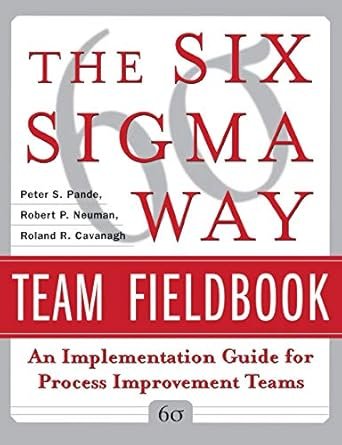
The Six Sigma Team by Greg Brue is a practical manual for understanding how to implement the Six Sigma approach in work teams to achieve continuous improvement in business processes. Six Sigma, a methodology widely known for its effectiveness in improving quality and reducing defects, is also a robust system for optimizing the performance of teams and organizations. Brue, an expert in this discipline, explores how teams can apply the principles of Six Sigma to work more efficiently, collaboratively, and effectively, with a particular emphasis on improving organizational performance.
Through The Six Sigma Team, Brue shares how this approach can transform not only the quality of work but also the culture of organizations, promoting collaboration, shared responsibility, and data-driven decision-making. This book is ideal for business leaders, project managers, and any professional looking to apply the Six Sigma method to enhance their team’s results and achieve their organizational goals.
The Six Sigma Philosophy: Beyond Defect Reduction
At its core, Six Sigma is based on the idea of continuously improving processes and reducing variability that causes errors or deficiencies in production. Traditionally, Six Sigma has been associated with the manufacturing industry, but Brue shows that its principles are equally applicable in teamwork and project management. The Six Sigma approach not only focuses on the quality of the final product but also on creating a culture of excellence, where continuous improvement is a shared responsibility among all team members.
Brue explains that to effectively implement Six Sigma, organizations must focus on customer needs and work to eliminate any barriers that interfere with delivering continuous value. This not only improves product quality but also optimizes internal processes and promotes efficiency, communication, and data-driven decision-making.
Six Sigma Teams: Collaboration and Shared Responsibility
The success of any continuous improvement methodology largely depends on the effectiveness of the teams that implement it. In The Six Sigma Team, Brue delves into how teams can work together more efficiently, leveraging individual strengths to achieve common goals. According to Brue, teams must be autonomous, responsible, and committed to the process of continuous improvement.
The role of the team leader:
A key component in implementing Six Sigma is the role of the team leader. Instead of being an authoritarian figure, the leader should act as a facilitator who guides the team towards problem-solving, supporting continuous learning and development. Brue emphasizes that the leader’s ability to foster collaboration, open communication, and shared responsibility is essential for creating effective teams that achieve significant improvements.
The Importance of Data in Decision-Making
One of the pillars of Six Sigma is data-driven decision-making. Brue stresses that teams must be able to analyze data effectively to identify areas that require improvement and measure the impact of implemented solutions. Through tools such as statistical analysis, flowcharts, and root cause analysis, teams can accurately identify the problems affecting their performance and make informed decisions to resolve them.
Impact on organizational performance:
By making data-driven decisions, organizations can achieve substantial improvements in their performance. Brue shows how teams can leverage this data not only to improve processes but also to increase customer satisfaction, reduce costs, and enhance operational efficiency. The key is to use data proactively, not just as a diagnostic tool but also as a mechanism to drive positive change.
The Stages of a Six Sigma Project: Planning, Execution, and Evaluation
In The Six Sigma Team, Brue also details how teams can manage a Six Sigma project through its various stages: Define, Measure, Analyze, Improve, and Control (DMAIC). These stages provide a clear structure to guide teams in their work, ensuring that project objectives are aligned with the organization’s and customer’s needs.
Define and measure:
The first step in the DMAIC process is to define the project’s problems and objectives. The team must fully understand the customer’s expectations and set clear goals that will guide the project. In the measurement phase, data is collected to understand the current state of the process and its performance.
Analyze, improve, and control:
In the analysis phase, teams seek the root cause of identified problems, allowing them to develop effective solutions. The improvement phase focuses on implementing these solutions and optimizing processes. Finally, in the control phase, the team implements monitoring systems to ensure that improvements are sustainable in the long term.
Benefits of the Six Sigma Methodology for Teams
The impact of implementing Six Sigma is profound. According to Brue, teams that adopt this approach enjoy greater cohesion, shared responsibility, and a focus on continuous improvement. As teams adopt the Six Sigma mindset, they not only improve their performance but also develop a strong organizational culture that values quality and innovation.
Conclusion:
The Six Sigma Team by Greg Brue offers a detailed guide to applying the Six Sigma methodology in work teams. Through a data-driven approach, effective collaboration, and continuous improvement, teams can transform the quality of their performance and contribute to the organization’s success. This book is an invaluable tool for any leader or team member looking to improve their effectiveness, increase efficiency, and achieve exceptional results through the implementation of Six Sigma principles.