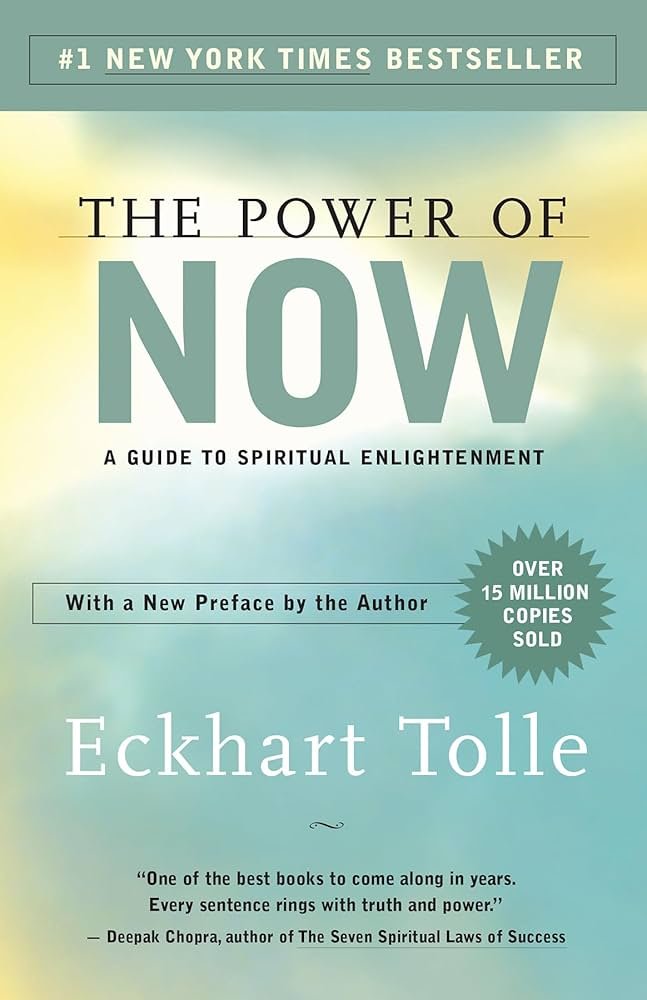
The Power of Now by Eckhart Tolle, published in 1997, is a groundbreaking work in the realm of personal growth and spirituality. This book has become a global phenomenon, transforming the lives of millions of readers by offering a profound insight into how to free ourselves from suffering and find inner peace by focusing on the present moment. Tolle invites us to practice full awareness, a path to enlightenment that helps us disconnect from worries about the past and future, to live fully in the now.
In The Power of Now, Tolle posits that human suffering stems from our identification with the mind, which constantly projects us into the past or future, preventing us from living authentically and presently. This book unfolds as a dialogue with the reader, offering a path to understanding how we can free ourselves from mental patterns that generate stress and anxiety, and rediscover the deep peace that lies in the now.
The Trap of the Ego and Identification with the Mind
One of the key concepts Tolle explores is the idea of the ego and how we identify with it, which distances us from the experience of the present. According to the author, the ego feeds on the past and future, finding its identity in the stories and labels we assign ourselves. Living under the influence of the ego means not only being trapped in memories and regrets but also constantly projecting ourselves into the future, anticipating what might happen.
The ego, in this sense, becomes an obstacle to experiencing life as it is, in its pure state. Tolle suggests that the key to freeing ourselves from this cycle is to become aware of our identification with the mind and start dissociating from our thoughts, recognizing that we are not our thoughts but observers of them. This awakening to the consciousness of the “now” is the first step towards inner peace.
The Now as a Gateway to Enlightenment
The central concept of The Power of Now is the importance of being completely present in the current moment. Tolle explains that the present moment is the only reality that truly exists, while the past is just a memory and the future is a mental projection. By focusing on the present, we free our minds from distractions and worries that prevent us from enjoying life.
For Tolle, the now is a state of pure consciousness, free from the interference of the ego and compulsive thoughts. Through the practice of being present, we can experience a direct connection with our deepest essence, a state of peace and well-being. This state is what Tolle describes as enlightenment, which is not something sought in the future but something experienced in the now.
The Inner Observer: Practicing Full Awareness
The author introduces the idea of the “inner observer” as a key tool to break identification with the mind. The observer is that part of us that can watch our thoughts, emotions, and reactions without identifying with them. This is a fundamental step in the process of self-discovery and liberation.
By distancing ourselves from our thoughts and emotions, we can start living without the burden of constant judgment and self-criticism. Tolle encourages readers to practice “awareness of the now” through meditation and observation of our thoughts, which allows us to achieve greater mental clarity and emotional tranquility.
The Relationship Between Body and Mind
In The Power of Now, Tolle also emphasizes the importance of being in tune with our physical body as a way to anchor ourselves to the present. The mind tends to scatter, but the body is always in the here and now. By focusing on our bodily sensations and learning to connect with our body, we can rediscover the power of the present.
This somatic approach helps us release accumulated tensions and teaches us to live more consciously. Tolle recommends practices such as meditation focused on breathing and bodily sensations to help us remain present.
Inner Peace Through Detachment
Another crucial aspect Tolle addresses is detachment. To experience the power of now, we must learn to let go of our need to control the future and free ourselves from the past. Detachment does not mean giving up goals or desires but rather letting go of the need to cling to them and trusting in the natural flow of life.
When we stop resisting the present moment, we stop generating unnecessary suffering. Fear, anxiety, and stress often stem from our resistance to the moment as it is. Accepting and flowing with the now allows us to live with greater harmony and inner peace.
Daily Enlightenment: Living the Now in Our Daily Lives
Tolle reminds us that enlightenment is not a mystical or distant state but a daily practice. Living the now does not require escaping from daily life but integrating full awareness into every moment. Whether in our social interactions, at work, or in the simplest activities, we can practice presence.
The author encourages us to find peace in the most mundane aspects of life, as the now is always available, even in the most ordinary moments. By stopping the search outside ourselves for what is already within, we discover that peace and fulfillment are within everyone’s reach, at any time and place.
Conclusion: Freeing Ourselves from the Past and Future
The Power of Now is a work that invites profound personal transformation. Eckhart Tolle teaches us that suffering comes from our disconnection with the present and our identification with the mind. By learning to live in the now, we not only free ourselves from suffering but also access a richer, fuller, and more conscious life.
The practice of being present is, according to Tolle, the key to unlocking our inner peace and finding a deeper connection with ourselves. Living in the now is not just a way to escape problems but a way to embrace life as it is, with all its complexities and beauties. In doing so, we approach a state of peace and serenity that transforms our experience of life.